


Tsundoku | Malaphor | Ablaut reduplication | Social medicine | Neighborism | Scientology run
This week in phraseology

Hello! In this edition, we have linguistic gymnastics1, book bliss, a blip of a “kids these days” trend, further proof that we do need each other, actually, and more.
Let’s get to it!
1. Tsundoku
If you’re a reader, you’ll enjoy this one, discovered via Jono Hey at Sketchplanations, a go-to source for learning cool new things. Each week, the artist and writer does a sketch to illustrate a concept to help make sense of it, and he’s done them weekly since 2013! I know maintaining streaks is a behavior that is both very of this Internet era and often not great for ye olde menty health, but I kinda dig this one.
According to Hey, Tsundoku is one of those perfect words that describes a very specific behavior—in this case, keeping piles of books around without reading them:
I find tsundoku rather aspirational. A desire to learn and read, backed up by your wallet, and you either have more than you can manage or you’re too busy doing other non-book things to get through them all. Good for you.
I found the origin of this Japanese word in a lovely brief essay by Antoine Wilson on Literary Hub called The Pleasures of Tsundoku, Or: How I Learned to Stop Worrying and Love Book Piles:
Tsundoku dates from the Meiji era, and derives from a combination of tsunde-oku (to let things pile up) and dokusho (to read books). It can also refer to the stacks themselves. Crucially, it doesn’t carry a pejorative connotation, being more akin to bookworm than irredeemable slob.
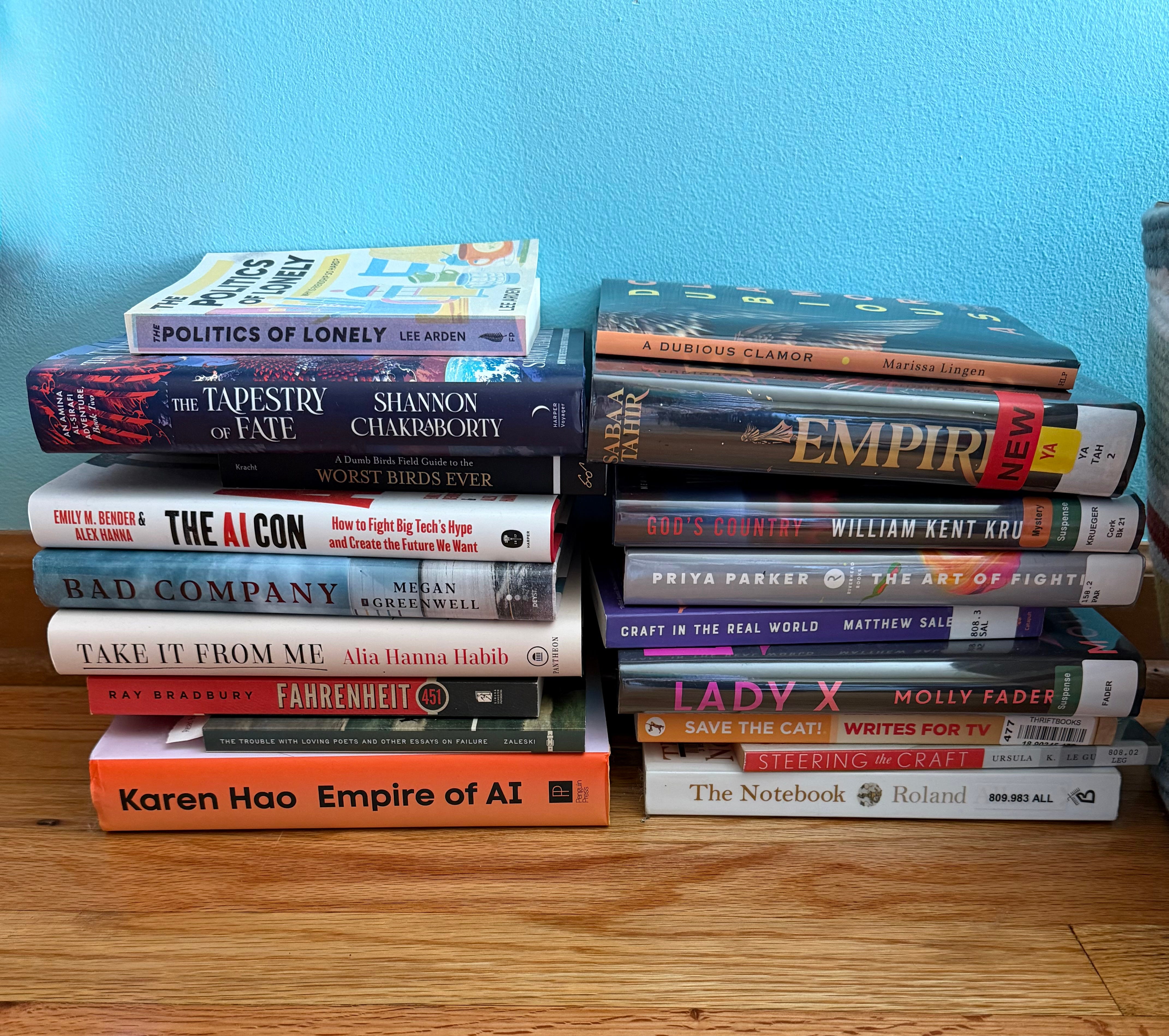
As internet enshittification continues at breakneck speed, making it harder to find accurate information, sourcing information in human-written books2 and reputable online texts will become a valued skill. So consider those book piles an investment in both your own brain power and our collective wisdom.
2. Malaphor
Wordpecker reader Noel sent this post about malaphors LAST YEAR and I’m just now getting around to writing about it. (Wordpecker tsundoku? You bet!)
I’ll illustrate the meaning of malaphor with a list from this “malaphors that don’t exist” clip from the Will and Rusty’s Playdate podcast:
Curiosity spilled the milk
Don’t judge a circus by its monkeys
Beating up the wrong bush
Shit or get out of the bag
If it ain’t broke don’t build it in a day
Don’t put all your eggs in one basket and eat it too
Got a favorite malaphor? Share it in the comments:
3. Ablaut reduplication
This is such a fun thing to learn and I am excited to share it with you! Via Merriam Webster, the very best to do it on social and a personal dream employer of mine:
If you can’t access the post above, the gist is: an ablaut is a type of systematic vowel variation that occurs in some languages. In the example shared here, lists of three words in English have I-A-O vowels in them (tic-tac-toe), and lists of two have I and either A or O (click-clack, King Kong). They go on to list common examples, reversing them to show how odd they feel (hop-hip, zag zig). Language is such an awesome gumball machine!
4. Social medicine
I found this article via the incredible folks in the Great Flyover Discord group, which you can join by subscribing to either the Men Yell at Me newsletter and podcast created by Lyz Lenz or The White Pages newsletter by Garrett Bucks. We talk a lot about what community means and why it matters in there, and we get to share nominations for the Dingus of the Week from Lyz.
Someone in the Discord shared this Bloomberg piece on social medicine (paywalled; archive.ph is your friend in these situations) that outlines how doctors in strained healthcare systems are prescribing social activities (shared hobbies like fishing, art classes, and more) to reduce depression and potentially improve chronic health conditions. The piece rightly notes that the greater need is actually systemic change to better support people (access to healthcare, housing, and education, labor rights, help during crises, etc.). But even then, so-called social prescribing could be an important source of support.
Most everyone I know is burnt crispy and struggling to maintain normalcy in the current hellscape, and many friends in my orbit are self-prescribing social medicine. Examples include in-person friend hangs, art workshops, group hikes, informal fiber arts meetups, and short group walks in the autumn sunshine hosted by my amazing local coffee/pottery shop.
Added to my tsundoku/TBR list from this piece: Art Cure: The Science of How The Arts Save Lives by Daisy Fancourt
5. Neighborism
This term pairs nicely with social medicine. I first discovered it via Rosie Spinks, who writes the excellent What Do We Do Now That We're Here? newsletter. Spinks recently addressed a reader question asking what creatives will do if we all lose our laptop jobs (something I am currently experiencing, btw, as businesses decide they don’t need humans to do content strategy or writing because Claude can do it faster and at less expense). Her response was that there’s no one she’d rather have around when everything goes to shit than her fellow scrappy creative collaborators. Hard agree!
As people become increasingly disempowered, we’re going to need each other more than ever. Spinks cites the neighborism displayed in Minneapolis in early 2026 in response to the unbridled cruelty ICE unleashed on residents.
Adam Serwer coined the term in an excellent Atlantic article about what MAGA got wrong about Minneapolis:
a commitment to protecting the people around you, no matter who they are or where they came from.
I have a small friend group that meets semi-regularly in the spirit of neighborism. We gather over snacks and talk about how we can help our neighbors and strengthen our ties among ourselves and our community. It’s been a great source of hope and laughter in 2026.
Added to my TBR list/tsundoku habit: Palaces for the People: How Social Infrastructure Can Help Fight Inequality, Polarization, and the Decline of Civic Life by Eric Klinenberg
6. Scientology run
Earlier this year, a TikTok “speed run” trend emerged that prompted people to race through the Scientology building in L.A. In one event, people dressed in costumes, including Jesus and Sonic the Hedgehog. As far as “Bad Things the Youngs Could Get Up To”, this doesn’t rank for a person (me) who used to roller skate in the back of St. Mark’s in middle school until a secretary kicked them (me) out. As with most stupid viral trends, this one seems to have died off.
Bonus Nuggets
1. Punny school printer names!
It’s been a minute since I’ve shared punny names for inanimate objects. Here are a few epic printer names from Chelsie Wilkerson (aka thecurlyhairedlibrarian), via Wordpecker reader Deborah:
If you can’t access the post, the printer names include: Dwayne Xerox Johnson, Scanley Tucci, Don’t Take That Toner With Me, and The Artist Formerly Known as Prints. Incredible work; chef’s kisses all around!
2. I would die for Dawn the Duck.
Here’s a Boston Globe article about Dawn for those of you not on Meta.
That’s it for this edition! See you in a couple of weeks. Remember to keep making it weird, and stay furiously curious!
A phrase that sort of serves as an example of ablaut reduplication!
Imagine my incandescent rage at having to frame books in this manner! 🔪